Loading the guide…
Understand transactional vs marketing email
Learn how the transactional and marketing distinction lives on the email content, what consent each type requires, and why maxclicks never sends cold email.
On this page
Every email maxclicks sends is either transactional or marketing. The difference decides who the message can reach, what consent it needs, and whether it carries an unsubscribe link. Getting this right keeps you compliant and keeps your sending reputation healthy. This article explains where the distinction lives, what each type is allowed to do, and the one rule you must never break.
Where the distinction lives
The most important idea is this: whether a message is transactional or marketing is a property of the content, not of how you send it. You set it once on the email template, and it travels with that content everywhere.
This means a broadcast, a stored template sent through the API, and a workflow send-email step all inherit the transactional or marketing status from the content they carry. You never toggle it on the send button.
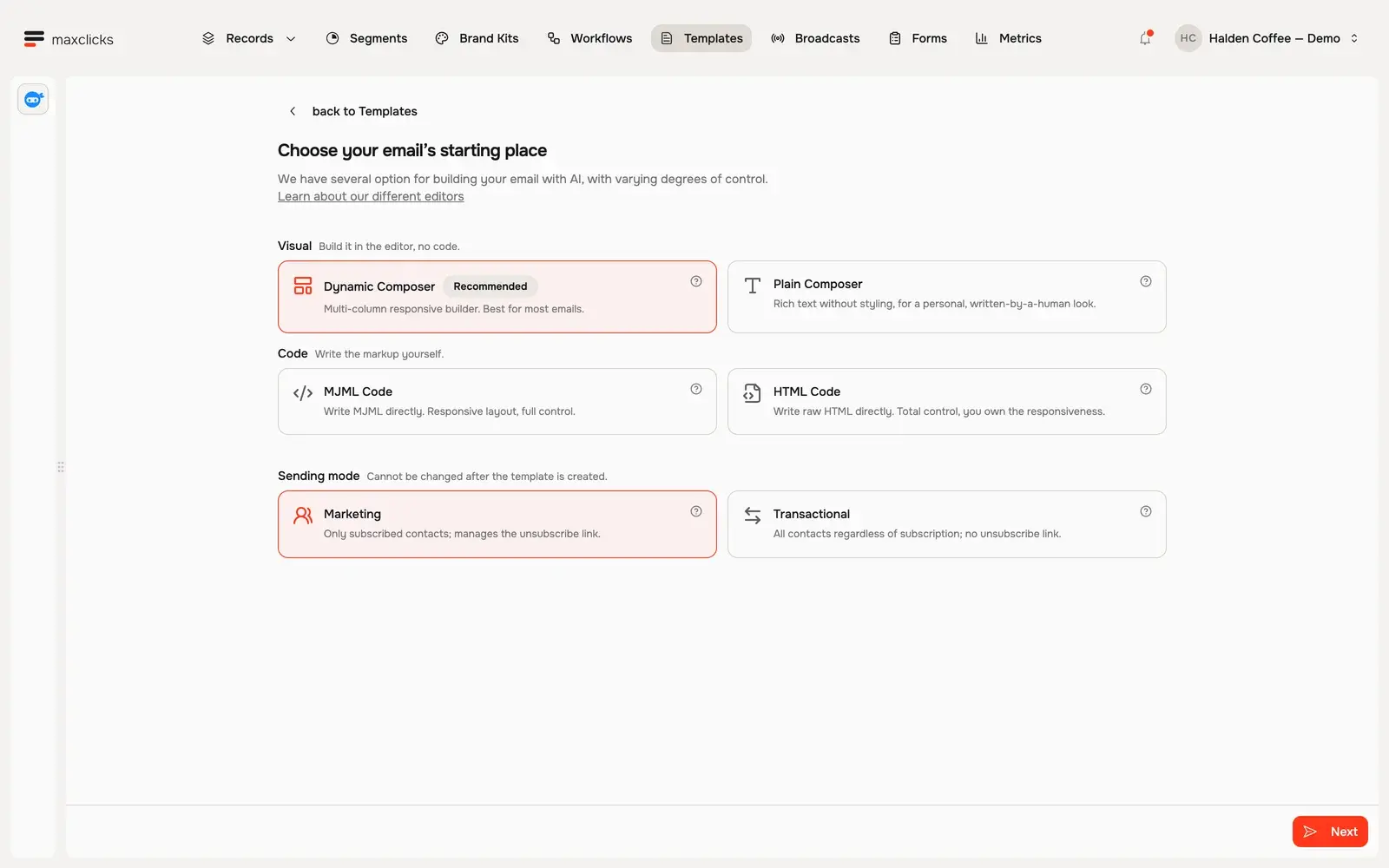
You pick the sending mode when you create the email template. The template picker's Sending mode section offers Marketing and Transactional, and the choice is fixed: it cannot be changed after the template is created, so a template started in the wrong mode has to be rebuilt. Decide before you start writing.
A communication topic is a named category of marketing mail, such as Marketing or Product updates, that a contact can subscribe to on its own. Binding an email to a topic narrows its audience to contacts who joined that topic. The topic works differently from the sending mode: you set it later in the composer, behind the Topic button, and can change it any time.
Because the flag is on the content, the same rules apply no matter which path sends the email. There is one universal rule set, described below, and every send runs through it.
What marketing email requires
Marketing is the default and the strictest type. It covers newsletters, promotions, product announcements, and anything that is not a direct response to something the recipient did. Marketing email carries the highest bar for consent.
A marketing send only proceeds when all of the following are true for the recipient:
- The contact has an active email subscription. A contact who never opted in, or who unsubscribed, is skipped.
- If the content is bound to a topic, the contact is a member of that topic. Topic membership is separate from the channel subscription.
- No suppression exists on the recipient's address. Any suppression at all blocks marketing mail.
Marketing email must be addressed to a contact, never to a bare email address. If maxclicks does not have a contact record for the person, it has no consent to check, so a marketing message cannot go out. Every marketing send also carries an Unsubscribe link in the footer and the RFC 8058 one-click headers, both injected for you. Read how those work in how unsubscribes and preferences work.
What transactional email can do
Transactional email is a direct, expected response to something the recipient did: an order confirmation, a password reset, a receipt, a shipping update. Because the recipient is waiting for it, transactional mail is held to a lighter consent standard.
A transactional send behaves differently in three ways:
- It bypasses the subscription and topic checks. It reaches a contact even if they have unsubscribed from marketing, because the message is not marketing.
- It is blocked only by bounce suppressions. A hard bounce on the address still stops it, because sending to a dead address hurts deliverability, but an unsubscribe or a manual suppression does not.
- It can be addressed to a plain email address that is not yet a contact, as well as to a contact. This is what carries a receipt to someone the moment they transact, before they exist as a contact record.
Transactional email still gets the standard footer with your brand details and company address, but it does not carry a marketing unsubscribe link, because there is nothing marketing to unsubscribe from.
How each sending path uses the distinction
Because the flag is on the content, each way of sending carries whatever the content says. It helps to see how the three paths map onto the two types.
- Broadcasts are marketing by nature. A broadcast is a mass send to a filtered audience of one contact schema, so it always runs the full consent, topic, and suppression checks and always carries the unsubscribe footer. You do not send a transactional broadcast; a broadcast is a campaign. Learn the flow in create and send a broadcast.
- Template sends through the API are the transactional workhorse. A stored template sent per recipient, triggered by something the recipient did, is the natural home for receipts, confirmations, and resets. It can be addressed to a contact or, because it is transactional, to a plain email address.
- Workflow send-email steps inherit their template's flag. A send-email step inside an order-confirmation flow is transactional; a step inside a nurture sequence is marketing. Either way, the step applies the same rule set before it sends.
The footer maxclicks injects is not optional. Every rendered send includes your brand footer, company mailing address, and social links, and marketing adds the Unsubscribe link on top. This is what keeps your mail compliant with the address-in-footer requirement that email law imposes.
Never mark marketing as transactional
The transactional flag skips the consent checks, which is exactly what makes it tempting to misuse, and misuse is where compliance problems start.
A good test is surprise: if the recipient would be surprised to receive it without having asked, it is marketing. A receipt for a purchase they just made is expected. A "we miss you, here is 20% off" note is not, even if you attach it to a past order.
The rules every send passes
Regardless of the path, broadcast, template send, or workflow step, every email runs through the same checks before it goes out. Understanding them explains why a message sometimes does not send.
| Check | What it enforces |
|---|---|
| Verified domain | The from-domain must be verified for sending. This applies to every send, test sends included: a test needs a verified domain and a picked sender. |
| Consent | Marketing needs the email subscription and topic membership. Transactional skips this check. |
| Suppression | Marketing is blocked by any suppression. Transactional is blocked only by a bounce suppression. |
| Credits and quota | Every plan stops at zero credits. The Free plan also stops at its 100 emails per month. |
| Rendering | Liquid and Adaptyle render the content, then the footer is injected, with an unsubscribe link for marketing. |
If any check fails, that recipient is skipped and the rest of the send continues. A single blocked contact never aborts a whole broadcast. To send at all, including a test, you first need a verified sending domain. A test send also counts against your email allowance and always goes out as transactional.
Walkthrough steps
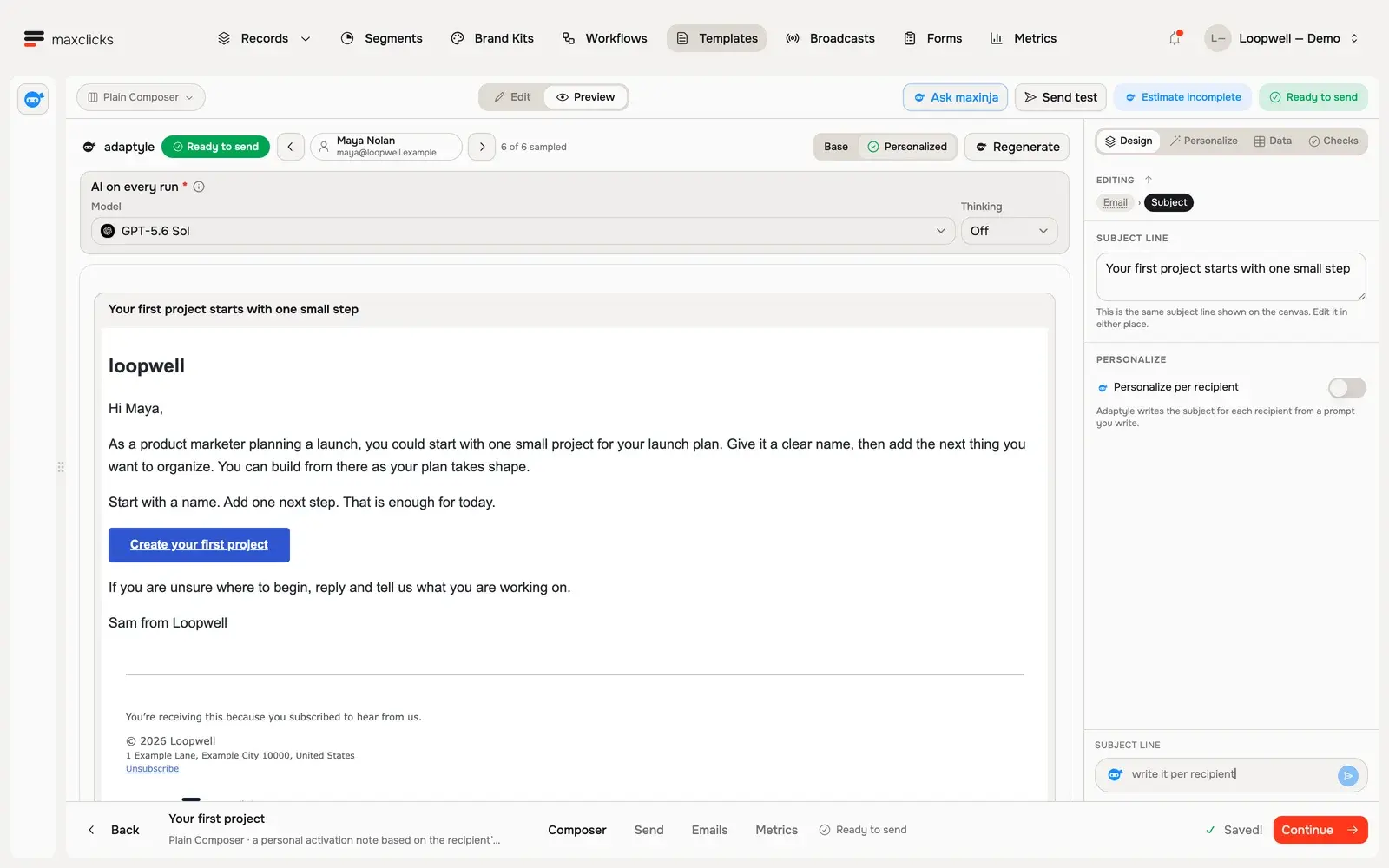
With Maya selected, request a real personalized preview and wait for it to finish. Read the generated next-step advice using her product marketing role and launch use case. The template retains its button, sign-off and footer. No email is sent; separate generations can vary.
The no cold email policy
There is one policy that no flag can change: maxclicks never sends cold outbound email. Marketing requires proven consent, and transactional is reserved for genuine responses to a recipient's own action. Neither is a channel for messaging people who never gave you their address.
This is deliberate. Cold outbound wrecks deliverability for everyone on shared infrastructure, and it is illegal in most of the markets maxclicks serves. Import only contacts who opted in, collect new ones through consenting forms, and let people leave whenever they want. That is what keeps your mail landing in inboxes.
Frequently asked questions
Where do I choose transactional or marketing?
In the template picker's Sending mode section, when you create the email template. It cannot be changed afterwards, so a template in the wrong mode has to be rebuilt. Every broadcast, stored template, and workflow send-email step then inherits the mode from the content it carries. A broadcast is always marketing by nature; transactional is used for API template sends and workflow emails that respond to a recipient's action.
Can a transactional email reach someone who unsubscribed?
Yes. Transactional email skips the subscription and topic checks, so an unsubscribed contact still receives their receipt or password reset. The only thing that blocks a transactional send is a bounce suppression on the address, because the address itself is failing.
Can I send a marketing email to an address that is not a contact yet?
No. Marketing must be addressed to a contact, because maxclicks needs a contact record to check consent against. Only transactional content can target a plain email address that has not become a contact. This is why receipts can go out instantly while a newsletter cannot.
Why was my marketing send skipped for some recipients?
A marketing send skips any recipient who is unsubscribed, is not a member of the bound topic, or has no email address. Those recipients are filtered out of the audience before the send starts, so they leave no run record: compare the audience count with the number of runs to see how many were excluded. A suppression is caught later, at send time, and does leave a failed run with a reason. Everyone eligible still receives the email.
Can I email a purchased list?
No. maxclicks never sends cold outbound email. Marketing requires proven opt-in consent, and transactional is only for genuine responses to a recipient's own action. Purchased or scraped lists have no consent and are not allowed.
Did this article answer your question?